.avif)
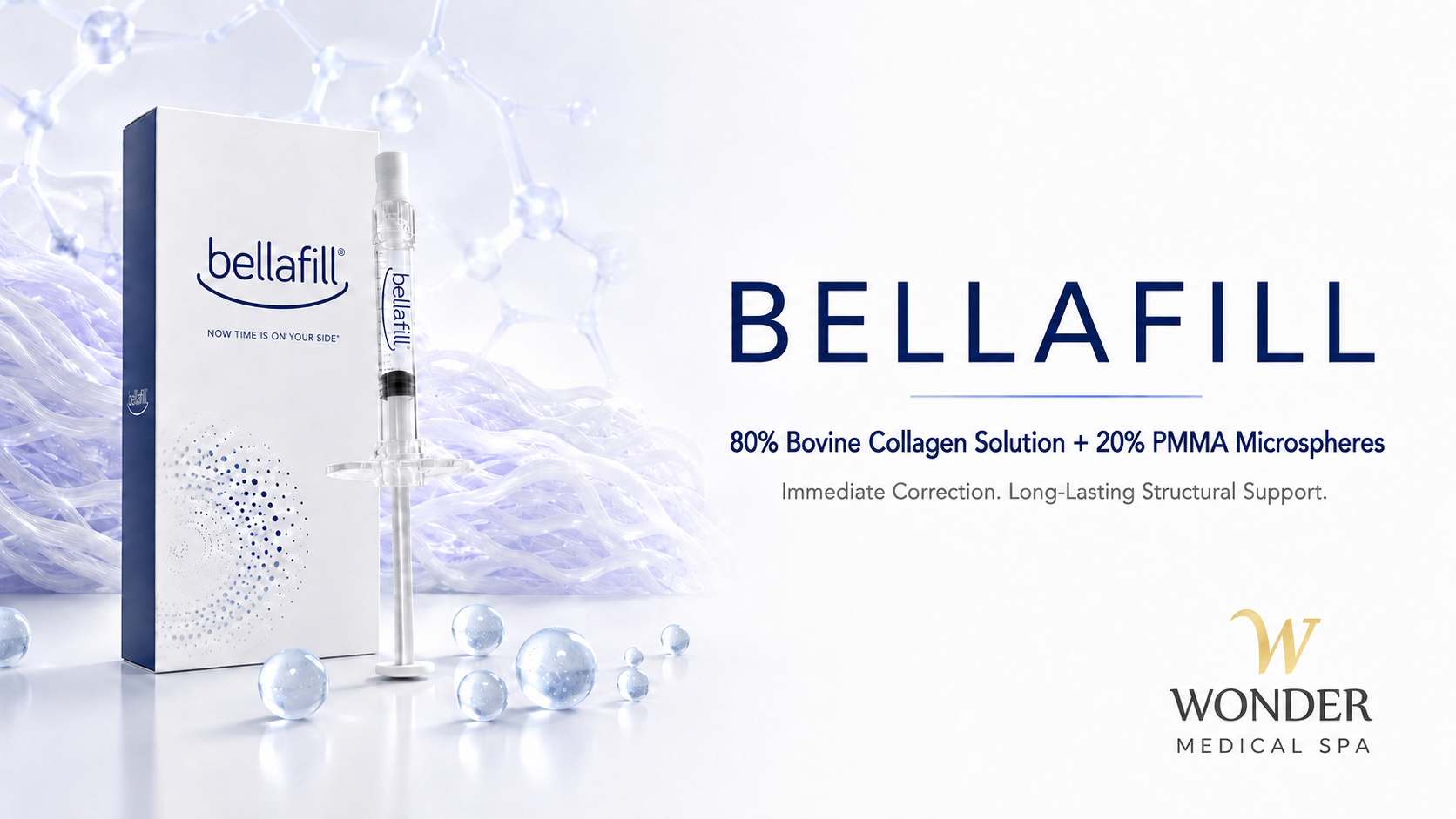
When choosing a dermal filler, many patients want more than temporary volume—they want a treatment designed to provide immediate correction and lasting structural support. Bellafill® stands apart from many traditional fillers because of its unique formulation: 80% bovine collagen solution and 20% polymethylmethacrylate, or PMMA, microspheres.
But what do these ingredients do, and why can Bellafill results last so long?
Key Takeaways
- Bellafill contains 80% bovine collagen solution and 20% PMMA microspheres.
- The bovine collagen provides immediate correction and initial volume.
- The PMMA microspheres remain in the tissue as a long-term structural scaffold.
- Bellafill is FDA-approved for nasolabial folds and certain atrophic, distensible acne scars on the cheeks in adults over age 21.
- Clinical studies have evaluated Bellafill results for up to five years.
- Bellafill cannot be dissolved like hyaluronic acid filler, so careful patient selection and precise placement are essential.
- A Bellafill skin test is required before treatment because the product contains bovine collagen.
What Is Bellafill?
Bellafill is an FDA-approved injectable filler indicated for the correction of nasolabial folds and moderate-to-severe, atrophic, distensible acne scars on the cheeks in adults over age 21.
Unlike hyaluronic acid fillers, which are gradually absorbed by the body, Bellafill contains non-absorbable PMMA microspheres. This creates a two-stage effect: the bovine collagen solution provides immediate correction, while the PMMA microspheres remain in place as a long-term support structure.
The 80%: Bovine Collagen Solution
Approximately 80% of Bellafill’s formulation is a bovine collagen-based carrier solution. Bovine collagen is collagen derived from cows and has a structure similar to collagen naturally found in human skin.
Once injected, the collagen solution immediately fills and supports the treated area. This can soften the appearance of nasolabial folds or elevate certain depressed acne scars, allowing patients to see visible correction shortly after treatment.
The bovine collagen component is gradually absorbed over time. Because Bellafill contains bovine collagen, patients must complete a skin test before treatment to screen for possible sensitivity or allergy. The test is generally performed approximately four weeks before the planned injection.
The 20%: PMMA Microspheres
The remaining 20% consists of tiny, smooth PMMA microspheres. PMMA is a biocompatible synthetic material that has been used in medical applications for decades.
Unlike the collagen carrier, these microspheres are not absorbed by the body. After the bovine collagen gradually breaks down, the PMMA microspheres remain beneath the skin and provide a scaffold around which the body can deposit its own collagen.
This combination helps preserve structural support within the treated tissue. It is also why Bellafill is considered a long-lasting—and essentially non-reversible—filler.
How Long Can Bellafill Last?
Clinical studies have evaluated Bellafill results for up to five years. Individual results vary depending on the treatment area, the amount injected, facial movement, anatomy, and the patient’s response.
Bellafill should not be described as a temporary filler. Because the PMMA microspheres remain in the tissue, thoughtful treatment planning and conservative placement are especially important.
What Can Bellafill Treat?
Bellafill is FDA-approved for:
- The correction of nasolabial folds
- Moderate-to-severe atrophic, distensible acne scars on the cheeks
- Adults aged 21 and older
Not every acne scar is suitable for Bellafill. Ice-pick scars, tethered scars, active acne, and other scar types may require a different treatment plan or a combination of procedures.
Is Bellafill Right for You?
Bellafill may be an option for patients who want long-lasting correction and understand that PMMA cannot be dissolved like hyaluronic acid filler. A consultation is necessary to review your anatomy, medical history, allergies, scar type, treatment goals, and previous procedures.
Because Bellafill contains bovine collagen, the required skin test must be completed and evaluated before treatment. Bellafill should only be administered by a qualified, appropriately trained healthcare professional.
Bellafill Frequently Asked Questions
Is Bellafill made from cow collagen?
Bellafill contains a bovine collagen solution, meaning the collagen is derived from cows. More precisely, each syringe contains approximately 80% bovine collagen solution—not 80% pure collagen—along with 20% PMMA microspheres.
What does the bovine collagen do?
The bovine collagen solution acts as a carrier gel and provides immediate correction after injection. It initially supports and fills the treated tissue before being gradually absorbed by the body.
What does PMMA do?
PMMA microspheres remain in the tissue and create a structural scaffold. The body can deposit its own collagen around this framework, helping maintain longer-term correction.
Is Bellafill permanent?
Bellafill contains non-absorbable PMMA microspheres that remain in the tissue. Although clinical results have been evaluated for up to five years, the PMMA component is considered permanent and cannot be dissolved with an enzyme.
Can Bellafill be dissolved?
No. Unlike hyaluronic acid fillers, Bellafill cannot be dissolved with hyaluronidase. Removing PMMA may require a physical or surgical procedure, which is why conservative treatment and an experienced injector are especially important.
Why is a skin test required?
The skin test helps screen for sensitivity to bovine collagen. It is typically administered approximately four weeks before treatment. Patients with a positive test should not receive Bellafill.
Is Bellafill FDA-approved for acne scars?
Yes. Bellafill is FDA-approved for treating moderate-to-severe, atrophic, distensible acne scars on the cheeks in patients over age 21. Not all types of acne scars qualify, so an in-person evaluation is necessary.
How quickly will I see results?
The bovine collagen solution provides visible correction immediately after treatment. Some temporary swelling may also be present, so the initial appearance is not necessarily the final result.
How much downtime should I expect?
Many patients return to normal activities shortly after treatment. Temporary swelling, redness, tenderness, bruising, itching, or small bumps may occur. Your provider will give you personalized aftercare instructions.
Who should not receive Bellafill?
Bellafill may not be appropriate for patients with bovine collagen or lidocaine allergies, certain severe allergies, bleeding disorders, a tendency to develop keloids, active inflammation or infection in the treatment area, or a positive Bellafill skin test. A licensed medical provider must determine candidacy.
Discover Long-Lasting Support with Bellafill
Bellafill’s dual-action formulation offers both immediate correction from its bovine collagen solution and enduring structural support from PMMA microspheres. For carefully selected patients, it can provide a long-term approach to softening nasolabial folds or improving eligible acne scars.
Schedule a consultation with WONDER Medical Spa to learn whether Bellafill is appropriate for your skin, facial anatomy, and aesthetic goals.
Bellafill is a medical treatment and may not be appropriate for everyone. Risks can include redness, swelling, bruising, tenderness, lumps, infection, allergic reactions, granulomas, vascular complications, and other adverse effects. Results vary. A Bellafill skin test and medical evaluation are required before treatment.